


.png)
_edited.png)
Dr. Rebecca Lee Crumpler: Physician Pioneer
- RS

- 7 hours ago
- 9 min read
Dr. Rebecca Lee Crumpler or, how she has addressed herself in writing, Doctress Rebecca Lee Crumpler, was the first Black female to earn a medical degree in the United States. It was 162 years ago that she graduated from New England Female Medical College (NEFMC) on March 1, 1864.
What a way to honor her anniversary in this edition! Well, a pioneering woman who showed perseverance and dedication to help so many other underrepresented and oppressed people deserves recognition beyond what this piece can give, but I digress.
Perhaps it was very fitting that Dr. Crumpler would become a physician. She was born in 1831 in Christiana, Delaware, to Absolum Davis and Matilda Webber, but was raised by her aunt in Pennsylvania.
Dr. Crumpler describes her “kind aunt”— a “community healer and midwife” whose “usefulness with the sick was continually sought”— as having inspired the pioneer to “[seek] every opportunity to be in a position to relieve the sufferings of others.”
Well, that, Dr. Crumpler sure did, and with amazing determination.

First, following in her aunt’s footsteps, Dr. Crumpler worked as a “nurse” (as there was no formal nursing program in the US until 1872) from 1852 to 1860, mostly in Charlestown, MA.
Then, in the midst of the Civil War, Dr. Crumpler completed her medical degree at NEFMC (on a scholarship from the Wade Scholarship Fund, indeed). Even more, halfway through her medical degree, she had to take a leave of absence to care for her TB-stricken husband, Virginia laborer Wyatt Lee, who passed from the disease in April 1863.
On top of everything, she faced intense opposition from school faculty in applying for re-entry into the program. Faculty tried to block her re-entry (and graduation), with meeting records showing that they claimed she showed “slow progress in learning” and that she “did not have the sufficient skills to become a physician,” but abolitionist patrons of the school successfully advocated for her re-entry and graduation.
What a woman. What a force. What a pioneer.
Amidst systemic barriers and personal hardship, Dr. Crumpler secured her legacy as the first Black woman to earn an M.D. in the United States. (And, no, M.D. does not stand for “mule driver,” as some fellow healthcare professionals mocked Dr. Crumpler during her professional career.)

Dr. Crumpler then started her formal medical career in Boston and Canada, before moving to Richmond, VA to practice what she describes as “real missionary work” with formerly enslaved people.
She practiced here with the Freedman’s Bureau, focusing much on women and children. After 4 years, she returned to Boston with “...a renewed vigor, practicing outside, and receiving children in the house for treatment; regardless, in a measure, of remuneration.”
Systemic barriers ever-present, she practiced from her home because she was denied admitting privileges to local hospitals. Further, Dr. Crumpler had difficulty getting her prescriptions honored by pharmacists, and prevailed amidst ridicule from fellow physicians and administrators (recall those “mule driver” slurs).
Dr. Crumpler was a trailblazer, an exemplary physician, who was a steadfast advocate for the health of her community, offering medical care to those who would not receive it, otherwise (and for free, as needed).
She was pretty extraordinary, right? Well, there’s even more…

After Dr. Crumpler stopped treating patients around 1880, she did another pioneering thing: She became what is believed to be the first Black person to write a medical text.
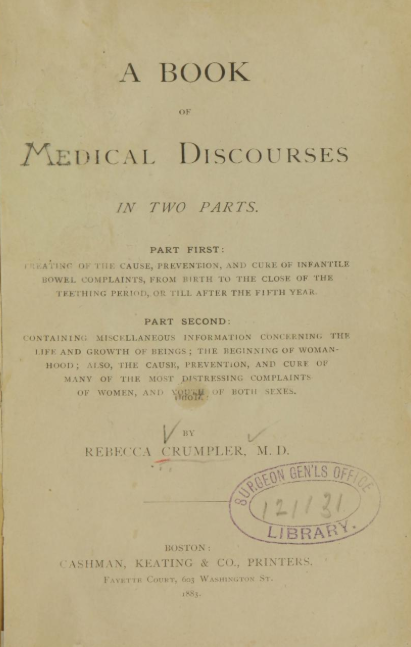
Her 1883 book, A Book of Medical Discourses, is “…addressed to mothers, nurses, women generally," and it focuses on detailing the treatment and care of women and children.
She mentions that she released this book with “no small degree of diffidence,” for it was a “…long-kept journal” throughout her clinical practice.
In line with her focus on accessible community care, in her book, Dr. Crumpler states:
...I desire to present the different subjects by the use of as few technical terms as possible; and to make my statements brief, simple, and comprehensive. Indeed I desire that my book shall be as a primary reader in the hands of every woman; and yet none the less suited to any who may be conversant with all branches of medical science. If women are permitted to read and reflect for themselves, it is hardly possible that they will say it is uninteresting to them, or that it should only be read by men.
What a stark contrast to the unyielding, unfair, and unrighteous barriers she faced in treating her patients.
Dr. Crumpler typified the very best of what it means to be a physician, living the Hippocratic Oath by “[benefiting her] patients according to [her] greatest ability and judgement, [and doing] no harm of injustice to them.”
She fought hard for herself and fought hard for her patients.
Dr. Crumpler was a pioneer in so many ways.
Nonetheless, can you believe that there are no confirmed images of Dr. Crumpler?
Not only was she the first Black female physician and the first Black author of a medical text, but she is believed to have been an innovator in the field of public health, further advocating for preventative care before it was recognized as a legitimate medical approach.
In fact, in her book, she states “My chief desire in presenting this book is to impress upon somebody’s mind the possibilities of prevention.” Even more, she suggests that medicine or, in her words, “physicking” during pregnancy “...will cause sickly diminutive offspring, to say nothing of premature births,” which was before her time.
In fact, it wasn’t until the mid 20th century that teratology came about. Despite her innovative ideas and approach, she was excluded from medical societies and journals. It’s only within the past few decades, really, that Dr. Crumpler has been cited and recognized within the medical community. (Honestly, I’d never heard of Dr. Crumpler throughout my education in the sciences, though.)
So, what does this say? What does it take to be honored? What does it take to be recognized for your contributions to society, when so aptly deserved? What did it take for Dr. Crumpler to achieve her “firsts”?
Dr. Crumpler’s achievements go beyond aptitude for her field. To achieve all that she did, it took much more. It took a bit of perseverance, a bit of community, some faith and belief, and a bit of…so much more.
Today (and since its inception), the United States can be viewed as an interesting place, yes? You can say great things about the US, and you can say terrible things. Something you can say: Systemic oppression is a real thing here.
With some gathering of stats regarding the total US population and its physician population, without getting too in-the-weeds (but see citations for more info), for every Black, non-Hispanic physician in the US, there are some 10-12 White, non-Hispanic physicians.
Now, for every Black, non-Hispanic person in the US, there are some 5 White, non-Hispanic people. As such, White, non-Hispanic people in the US are about 2x more likely to become physicians vs Black, non-Hispanic people.
Historian Vanessa Northington Gamble has recorded that, when Dr. Crumpler graduated from medical school, there were 54,543 physicians in the country— 270 of them were White women, and 180 were African-American men, thus Dr. Crumpler being the only Black woman. Though we’ve improved from such stats, we do have a ways to go.
While there are many factors affecting the rate at which Black, non-Hispanic people become physicians, I want to focus on the systemic oppression of Black people within the US.
What is systemic oppression? It’s the institutionalized discrimination that’s woven into the fabric of our society, to the point that our cultural norms, laws, and policies cultivate discrimination. Being so entrenched, it can go unnoticed or outright rejected with almost no regard for the oppressed.
It almost seems that you need to have some kind of ironic "faith" in systemic oppression in order to believe it exists (this is not the case for everyone, of course).
Nonetheless, in the immortal words of James Baldwin:
“It is really quite impossible to be affirmative about anything which one refuses to question.…”
How do we reject systemic oppression without analyzing the relevant disparities in our criminal justice system, policing, housing wealth, and healthcare access and outcomes (see further readings)? Systemic oppression is insidious and commonplace.
In Native Son, Richard Wright explains the reality of systemic oppression quite well:
If only ten or twenty Negroes had been put into slavery, we would call it injustice, but there were hundreds of thousands of them throughout the country. If this state of affairs had lasted for two or three years, we could say that it was unjust; but it lasted for more than two hundred years. Injustice which lasts for three long centuries and which exists among millions of people over thousands of square miles of territory, is injustice no longer; it is an accomplished fact of life.
Though slavery was quite overt in its oppression, it took 246 years to be abolished— no federal reparations given then or today. Systemic oppression today is a “fact of life” that can go unrecognized and swept under the rug.
Our children continue to learn a, quite biased, history that plants the seeds of oppression into each generation, if not already present from the prior generations’ perspectives. Such systemic oppression has widespread effects.
In a 2021 publication, molecular anthropologist Connie J. Mulligan explains how systemic racism can affect gene expression which can, in turn, yield changes in physical and mental health (eg, higher blood pressure and premature biological aging).
Other studies have shown how direct and indirect exposure to racism can manifest similarly to post-traumatic stress disorder, how racial trauma is linked to a chronic stress response, and how it can threaten even one’s identity.
Dr. Crumpler experienced persistent, overt racism throughout her life, yet she had so many wonderful achievements (long-unrecognized, of course). The amount of counter-persistence and determination she had (not minimizing her communal support) is astounding.
Dr. Crumpler’s personality seems to come out in her book, with one word, “direct,” really coming to mind.
Dr. Crumpler wanted to “...relieve the suffering of others,” a mission outside of herself, to a great degree, and she directed her life toward such. Perhaps some of what it takes to achieve great things, in spite of oppression, is some communal support, some recognition of one’s own identity and capacities outside of labels, some luck, and the awareness of your existence within systemic oppression.
Dr. Crumpler expressed her awareness of the health disparities of Black people during her time, and she expressed her belief that she and her community were discriminated against.
With such awareness (as she showed), one can externalize such a social issue and gain clarity and reframe this illusion of inferiority. While Dr. Crumpler did not get the recognition she deserved during her time (she and her husband even had unmarked graves until, after much community effort, they were marked in July 2020), she achieved so much for herself and her community.
Sometimes the times are against the individual (and community) but, hopefully, one's positive impact will persist. One cannot minimize the power of systemic oppression, but we must do all we can, individually and communally, to overcome it; to foster ourselves and each other. The United States has surely progressed since Dr. Crumpler’s time, but we must hold ourselves accountable to each other. I believe that Baldwin’s message still rings heavy today:
Perhaps it now occurs to him that in this need to establish himself in his relation to his past [the African American] is most American, that this depthless alienation from oneself and one's people is, in sum, the American experience.
We are individuals, part of a collective framework of cultures, experiences, perspectives, and opinions. We influence each other, and our institutions influence us on a grand scale, obviously and insidiously.
We must realize our interconnectedness despite what we may be led to believe. Dr. Crumpler was determined to improve her community through “missionary work” as a physician. Despite her success, she was inextricable from the sufferings and oppression of her community.
Today, we can recognize her appropriately and, perhaps, learn that systemic oppression, in its formidable, powerful existence, is a living and breathing structure. The data show improvement, but it takes widespread awareness and effort to continually chip away at it, individually and communally.
Disclaimer: All images in this article, unless otherwise noted, were created using ChatGPT.
Naadia Salaam is a a writer, soccer player, adventurer, and fitness enthusiast. She writes to inspire, uplift, and inform.
Further reading:
American Association of Medical Colleges. 2023 Key Findings and Definitions. AAMC, 2023, www.aamc.org/data-reports/data/2023-key-findings-and-definitions.
Armstrong Economics. U.S. Population from 1776 to Date. Armstrong Economics,
www.armstrongeconomics.com/us-population-1776-date/.
Boston University. “Rebecca Lee Crumpler, First Black Female Physician, Gets Gravestone 130 Years After Death.” Boston University, 2020, www.bu.edu/articles/2020/rebecca-lee-crumpler-first-black-female-physician-gets-gravestone-130-after-death.
Centers for Medicare & Medicaid Services, Bureau of Health Workforce. State of the U.S. Health Care Workforce, 2025. Health Resources & Services Administration, 2025, bhw.hrsa.gov/sites/default/files/bureau-health-workforce/data-research/State-of-US-Health-Care-Workforce-2025.pdf.
Census Bureau, U.S. “Wealth by Race.” U.S. Census Bureau, Apr. 2024, www.census.gov/library/stories/2024/04/wealth-by-race.html.
Census Bureau, U.S. QuickFacts: United States. U.S. Census Bureau,
www.census.gov/quickfacts/fact/table/US/POP715223.
Drexel University, Legacy Center. “Is That Dr. Rebecca Lee Crumpler? Misidentification, Copyright, and Pesky Historical Details.” Drexel University, June 2013, drexel.edu/legacy-center/blog/overview/2013/june/is-that-dr-rebecca-lee-crumpler-misidentification-copyright-and-pesky-historical-details/.
HealthCity, Boston Medical Center. “What Is Systemic Racism in Healthcare? Causes, Impacts, and Solutions.” HealthCity, healthcity.bmc.org/what-is-systemic-racism-in-healthcare-causes-impacts-and-solutions.
National Library of Medicine. “Rebecca Lee Crumpler.” Changing the Face of Medicine, cfmedicine.nlm.nih.gov/physicians/biography_73.html.
National Park Service. “Dr. Rebecca Lee Crumpler.” National Park Service, www.nps.gov/people/dr-rebecca-lee-crumpler.htm.
PBS NewsHour. “Celebrating Rebecca Lee Crumpler, the First African American Physician.” PBS, www.pbs.org/newshour/health/celebrating-rebecca-lee-crumpler-first-african-american-physician
Scientific American. “America’s First Black Female Physician Cared for Patients from Cradle to Grave.” Scientific American, www.scientificamerican.com/article/americas-first-black-female-physician-cared-for-patients-from-cradle-to-grave.
Sentencing Project. Racial Justice. The Sentencing Project, www.sentencingproject.org/issues/racial-justice.
Statista. “Black and Slave Population in the United States from 1790 to 1880.” Statista, www.statista.com/statistics/1010169/black-and-slave-population-us-1790-1880.
Women’s History Museum. “Rebecca Lee Crumpler.” National Women’s History Museum, www.womenshistory.org/education-resources/biographies/rebecca-lee-crumpler.
Mulligan, Connie J. “Systemic Racism Can Get under Our Skin and into Our Genes.” American Journal of Physical Anthropology, vol. 175, no. 2, June 2021, pp. 399–405. doi:10.1002/ajpa.24290.Springer Nature. “Racial Trauma and Health: A Scoping Review.” BMC Public Health, 2025, link.springer.com/article/10.1186/s12889-025-25382-5.
Öztürk, Merve, et al. “Understanding Racial Trauma and Its Health Impacts.” Journal of Underrepresented and Minority Progress, vol. 7, no. 2, 2023, ojed.org/jump/article/view/6568.
Baldwin, James. Notes of a Native Son. Beacon Press, 1955.
Crumpler, Rebecca Lee. A Book of Medical Discourses. Cashman, Keating & Co., 1883.
Wright, Richard. Native Son. Harper & Brothers, 1940.


.png)

Comments