


.png)
_edited.png)
Worship Roots: How African Spiritual Practices Have Shaped the Black Church
- RS

- May 19
- 4 min read
“The most segregated hour in American life is high noon on Sunday.” – Malcolm X
Malcolm X’s words still ring true today. Forged in survival and resistance, practices in the Black church diverged from the form of Christianity that slaveholders tried to impose on enslaved Africans. Though Christianity was introduced as a means to encourage obedience and “good” behavior among enslaved people, ironically, it became a way for them to reconnect with African ritual and tradition. Enslaved people created their own safe space–even gathering in “brush arbors” and “hush harbors” to worship in secrecy–where they infused Christianity with elements of African spiritual traditions, communal rituals, and expressive forms of worship that laid the foundation of the Black church.
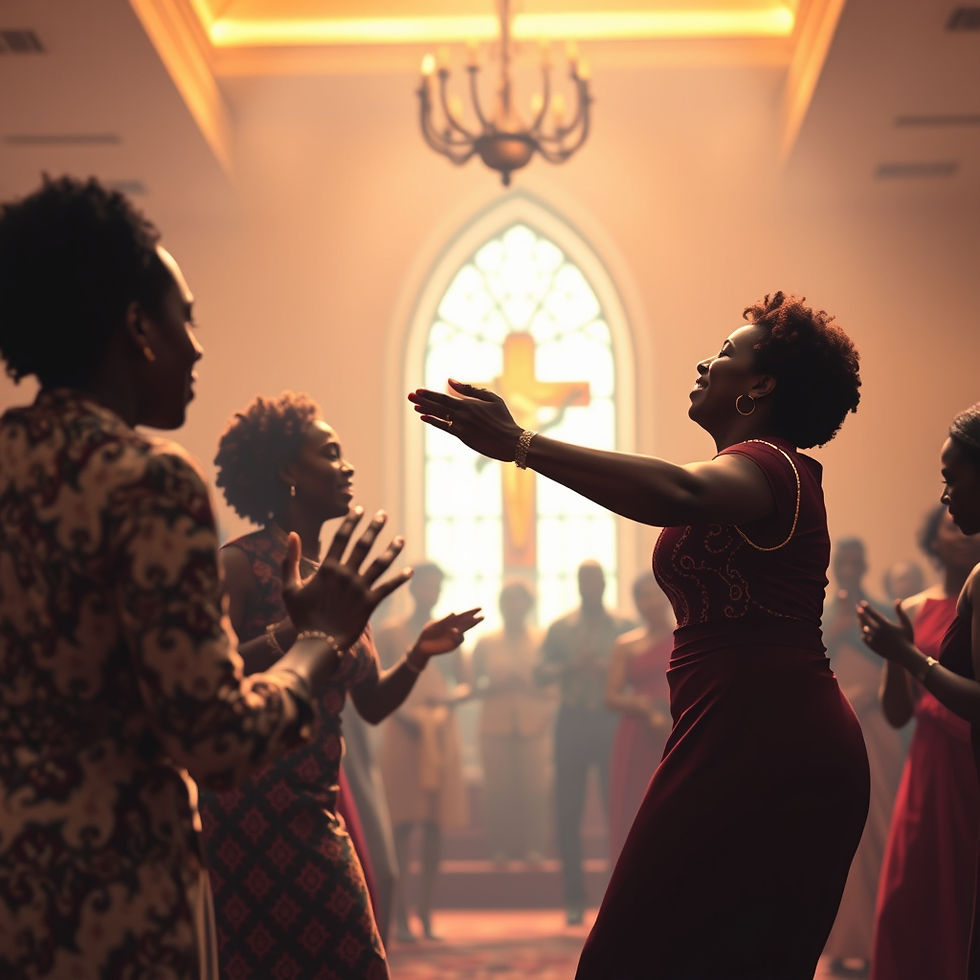
As quoted in Christopher Hunter’s article in Religions, The African American Lectionary notes that enslaved people founded praise houses in which worship featured “...spirituals that slaves crafted out of their understanding of the Bible and God, and African melodies that had been retained and passed down.” Then and now, song and dance are preeminent features of African culture, and we can see the life that these elements bring to the Black church. Walk by almost any Black church in the United States on a Sunday, and you will hear the music, the clapping, the shouts, and the melodic sermons that define a culture as much as they define the religion. The church is alive…lively. These activities appear to echo what Samuel Floyd depicts in describing the canonical African “ring shout” that blended into the early religious practice of enslaved people:
…the participants stood in a ring and began to walk around it in a shuffle, with the feet keeping in contact with or close proximity to the floor, and that there were "jerking," "hitching" motions, particularly in the shoulders. These movements were usually accompanied by a spiritual, sung by lead singers, "based" by others in the group (probably with some kind of responsorial device and by hand-clapping and knee-slapping). The "thud" of the basic rhythm was continuous, without pause or hesitation. And the singing that took place in the shout made use of interjections of various kinds, elisions, blue-notes, and call-and-response devices, with the sound of the feet against the floor serving as an accompanying device.
Though the “ring shout” can be separated from religious practice, it was a major theme within the Christian religious traditions of enslaved people. In fact, we still see it today in the “jerking” and “hitching” when someone is "filled with the Holy Spirit,” or in the stomping and clapping that give rhythm to the melodic call-and-response prayer. It is this possession by the “Holy Spirit” that Union Colonel Thomas Wentworth Higginson appears to detail in Patricia Averill’s piece on the practice of ring shouts:
Then the excitement spreads: inside and outside the enclosure men begin to quiver and dance, others join, a circle forms, winding monotonously round some one [sic] in the centre; some “heel and toe” tumultuously, others merely tremble and stagger on, others stoop and rise, others whirl, others caper sideways, all keep steadily circling like dervishes.

What a stark contrast to the traditional Christian practices that slaveholders tried to force onto enslaved Africans–and to the practices commonly on display in predominantly white churches, both then and today. Even the beat of the African drum still rings heavy in the Black church. Though it sounds different today, the percussive energy is the same. As cited again by Hunter, Noel Leo Erskine explains:
While white ministers emphasized memorization of the Lord’s prayer, the Ten Commandments, and various passages that highlighted obedience and submissiveness, for enslaved persons their love for church and religious services had to do with their love for singing, dancing, praying, and possession of the spirit, and later on when they had their own church, they included preaching and drumming. There were different agendas and quite often there was a misunderstanding on the part of white preachers.
In spite of this “misunderstanding,” the separation only continued to become more and more complete. The fact that the “Black church” is standard terminology underscores its distinction and enduring separateness. Yet the Black church cannot be separated from its African influences. The transatlantic slave trade brought enduring African traditions that merged into the lives of the enslaved people who were so forcefully torn from their roots. Nonetheless, the very religion that was introduced to control and “civilize” them was the very thing that reconnected them with their free, lively, and expressive African roots.
Further Reading
Averill, Patricia. Ring Shouts: Historic Descriptions and Contemporary Examples. 2018.
Floyd, Samuel A. “Ring Shout! Literary Studies, Historical Studies, and Black Music Inquiry.” Black Music Research Journal, vol. 11, no. 2, 1991, pp. 265–87.
Hunter, Christopher. “The African American Church House: A Phenomenological Inquiry of an Afrocentric Sacred Space.” Religions, vol. 13, no. 3, 2022, article 246.
Malcolm X, and Alex Haley. The Autobiography of Malcolm X. Grove Press, 1965.
“Performing Culture in Music and Dance.” African American History and Culture, Humanities LibreTexts, Lumen Learning


.png)

Comments